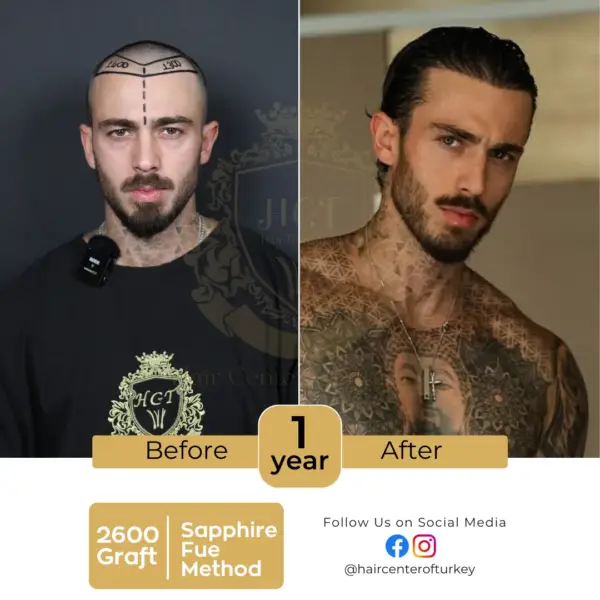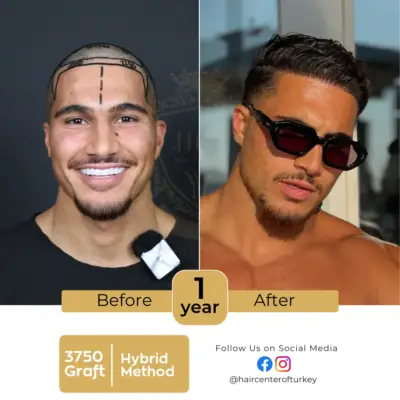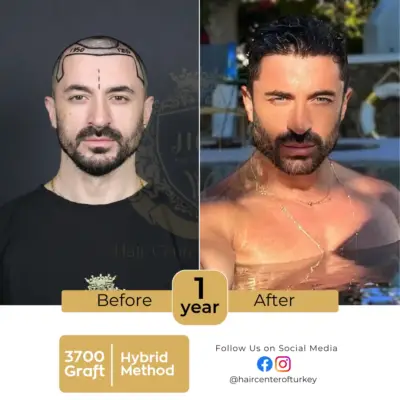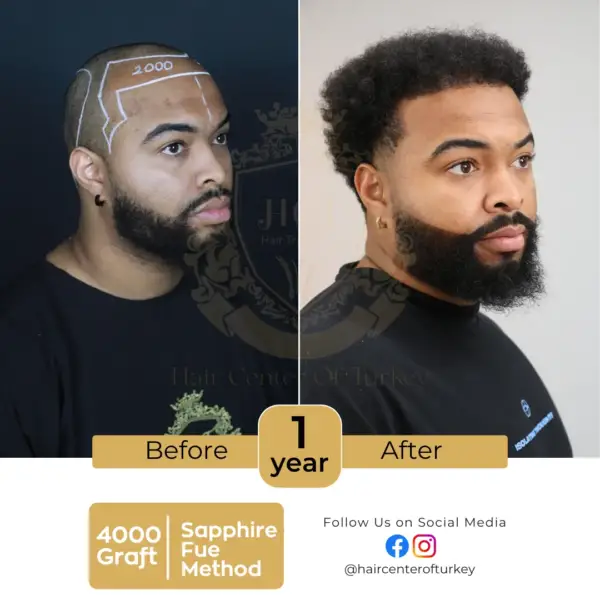


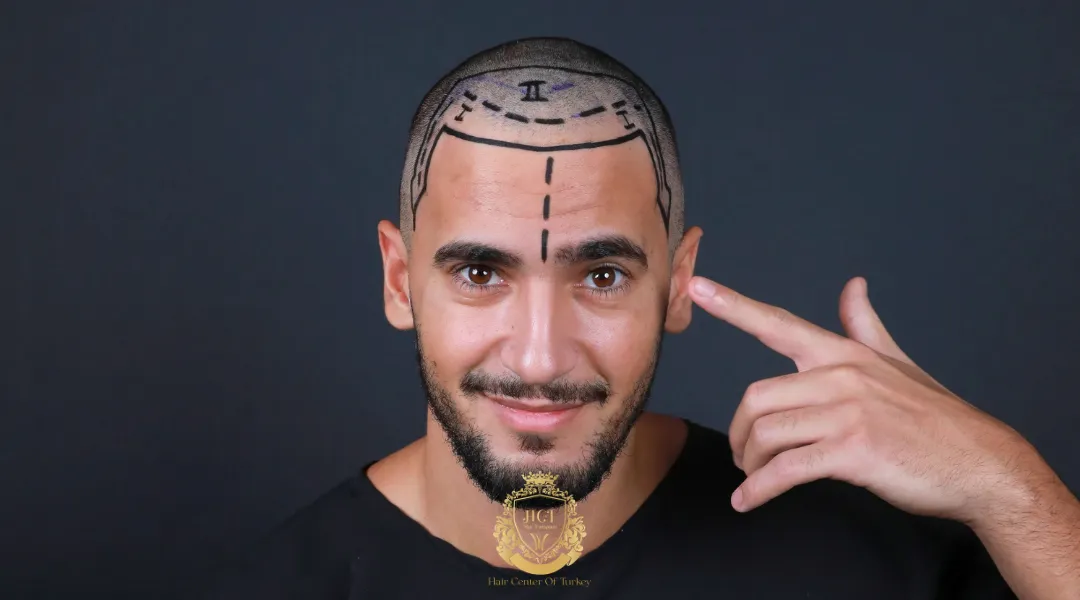
Online graft estimates differ because clinics estimate from photos, apply different density targets, and sometimes quote hairs instead of grafts.
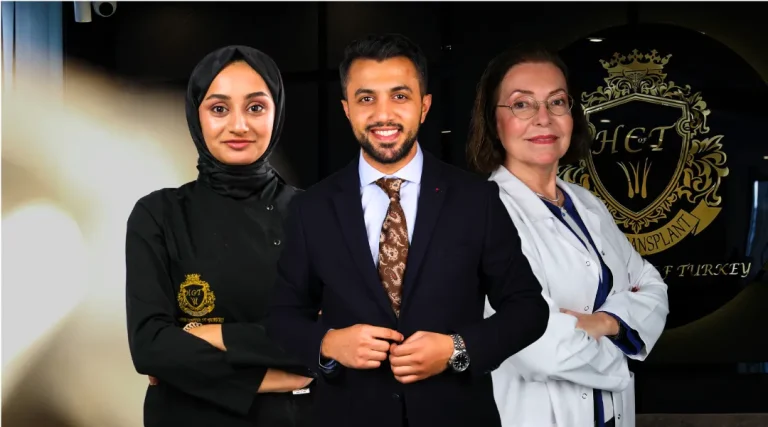
Three clinics, the same five photos, three different numbers. That spread rarely means two surgeons are wrong and one is right. It usually means nobody has measured your scalp yet. Hair Center of Turkey has been running this assessment since 2014, with three doctors on staff and roughly 3,000 procedures a year.
US patients can start with a free online pre-operative eligibility consultation. It returns a doctor-reviewed hair transplant graft range before a flight is booked or a deposit is paid.
The Short Answer: Why Your Quotes Don’t Match
A photo-based hair transplant graft count is a planning range, not a surgical plan. Remote estimating from images sits around 40-60% accuracy. Lighting, camera angle, styling product and wet versus dry hair all change how much thinning a picture reveals. Each clinic then applies its own target density per square centimetre, and that single assumption moves the number more than any difference in surgical skill.
Table of Contents
The second driver is the unit itself. A graft is a follicular unit holding one to four hairs, so 2,500 grafts can transplant 5,000 hairs or more. A clinic advertising 6,000 hairs and one quoting 2,600 grafts may be describing the same operation on the same head.
The third driver is who wrote the estimate. A sales coordinator reading WhatsApp images and a physician who measured donor density are doing different jobs, and their numbers reflect that. The free online hair consultation at Hair Center of Turkey closes that gap for US patients. You receive a documented, zone-by-zone plan covering hairline, mid-scalp and crown separately, with donor capacity held back for future loss.
One filter cuts through most of the noise. A quote worth trusting shows its measurements, names its unit, and leaves donor supply in reserve for the decade ahead. Anything that arrives as a single number with no reasoning attached is a price, not a plan.
What A Hair Transplant Graft Actually Is
A graft is not a hair. In restoration surgery, a graft is a follicular unit: a natural cluster of one to four hairs. Those hairs share a sebaceous gland, a small arrector pili muscle and their own blood supply. Surgeons harvest and place that unit intact, because splitting it damages the structures that keep the hair growing.
Scalps are built from a mix of these units. Single-hair units go along the hairline for a soft, irregular edge. Three and four-hair units sit behind them to build bulk.
The average number of hairs per graft varies between patients, usually between 2.0 and 2.5, and that ratio changes every coverage calculation.
Grafts Vs Hairs: Reading The Same Surgery Two Ways
Take a 2,500-graft plan. At 2.2 hairs per graft, that operation moves roughly 5,500 hairs. Quoted in grafts it sounds modest.
Quoted in hairs it sounds enormous. Both figures describe the same morning in the same operating room.
Hair characteristics complicate the comparison further. Coarse hair covers more scalp per follicle than fine hair, and curl adds apparent volume.
Low contrast between hair and skin hides thinning that dark hair on pale skin exposes. Two men with identical bald areas can legitimately need different numbers for the same visual result. Before comparing two prices, ask which unit each quote is written in.
How Surgeons Calculate Hair Transplant Graft Count
Every legitimate hair transplant graft count rests on three measurements. The recipient area is mapped in square centimetres. A target density in grafts per square centimetre is chosen for each zone.
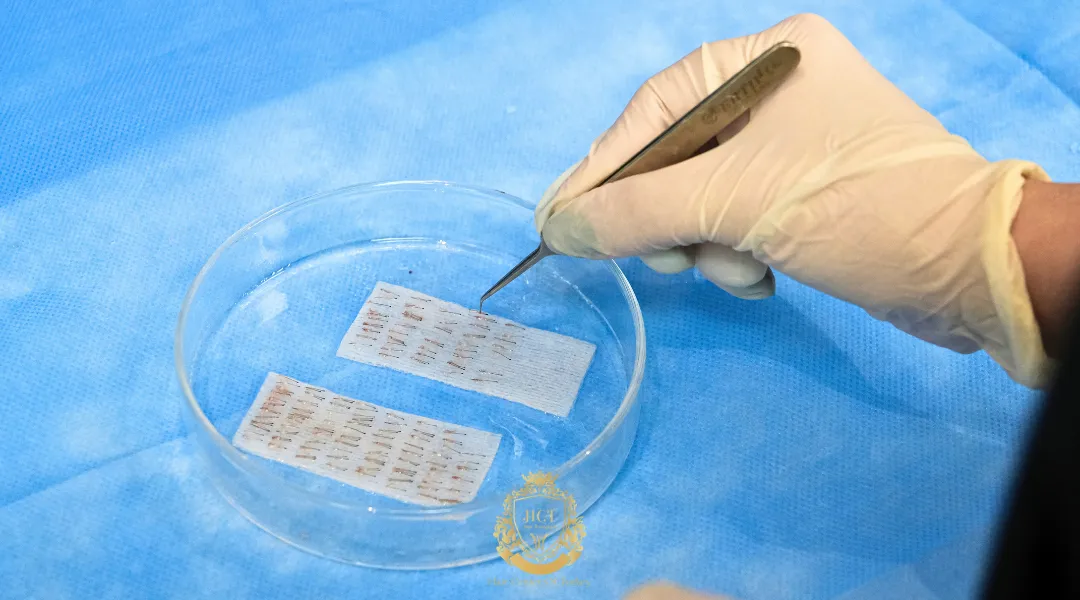
Donor supply is then measured to confirm it can cover the plan. Multiply the first two, check the result against the third, and the number has reasoning behind it.
Donor scalp yields roughly 90-100 follicular units per cm², and only part of that can be harvested without visible thinning. A recipient area of 100 cm² planned at 30 grafts/cm² needs 3,000 grafts. The same area at 45 grafts/cm² needs 4,500. Nothing about the patient changed between those two figures.
Target Density And Why Half Of Native Density Looks Full
Native scalp density runs around 60-100 follicular units per cm². Transplanted areas are usually restored at 40-50 grafts/cm², roughly half of that. The eye reads shadow and overlap rather than counting follicles, so a natural result does not require matching the original density. Past that range, extra grafts consume donor supply without producing a visible gain.
This is where most of the quote spread lives. Shifting the target from 25 to 40 grafts/cm² on an identical scalp changes the estimate by about 60%. That is arithmetic, not artistry. It explains how an aggressive clinic and a conservative one can both be internally consistent while disagreeing by thousands of grafts.
Template quoting creates the same effect from the other direction. Treating every Norwood stage 5 patient as a 3,000-graft case ignores that hairlines, mid-scalps and crowns recede at different rates over different areas. Zone-by-zone planimetry measures each region separately. That is why a real plan lists three or four numbers instead of one.
Why A Photo Cannot Replace An In-Person Donor Assessment
Remote estimating has structural limits that experience does not remove. Overhead lighting flattens thinning while side lighting exaggerates it. Wet hair reveals scalp that dry hair hides. Fibre products or a changed part can erase a diffuse zone from view entirely.
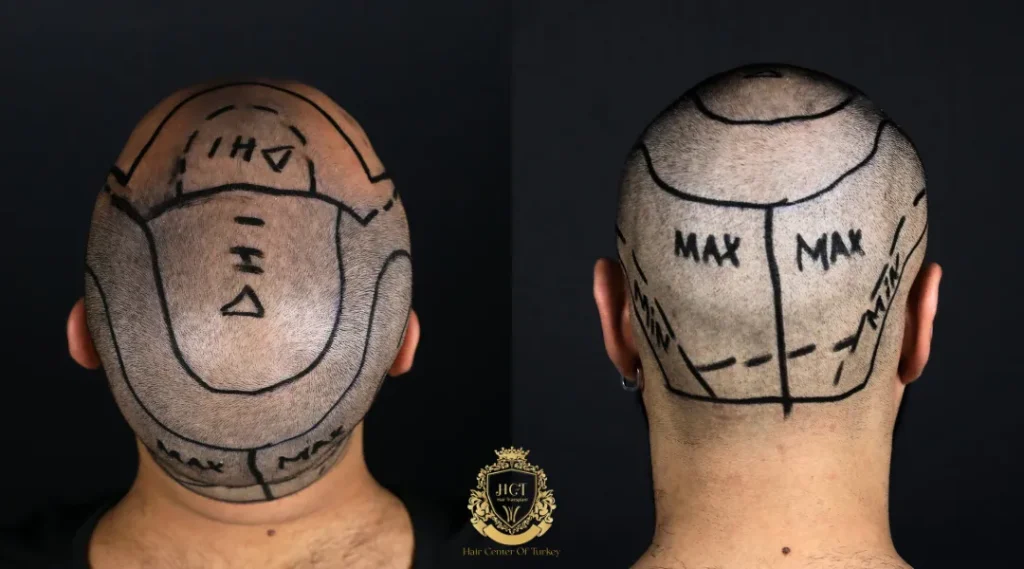
The accuracy gap is measurable. In-person trichoscopy and planimetry are reported at roughly 90-95% accuracy, while photo-based graft calculators land nearer 40-60%. The online figure tells you whether you are a 2,000 or a 4,000 candidate. The in-clinic figure is the plan.
Miniaturisation is the part a camera cannot capture. Under trichoscopy, zones that look covered in a photograph often show shortened, thinning follicles on their way out within a few years. Those hairs count as coverage today and as empty scalp in five years. A surgeon planning for where your hairline will sit in a decade quotes differently from one planning for today only.
Donor assessment also decides what is possible, not only what is needed. Two patients with the same recession can have donor densities of 65 and 100 follicular units per cm², and the safe harvest ceiling moves with it. A hair transplant graft estimate signed by a physician who measured that figure carries different weight than one typed by a coordinator reading phone images.
Risks, Exceptions And The 5000 Graft Hair Transplant Promise
Donor supply is a lifetime budget, not a per-session allowance. Most patients hold roughly 4,000-6,000 usable grafts for life. Follicles removed for one session leave the account permanently, and nothing regrows in the extraction sites. Loss continues after surgery, so a plan that spends the whole budget at 32 removes the option of covering the crown at 45.
Census data puts the common promises in perspective. The ISHRS 2025 Practice Census, reporting 2024 data, found an average FUE case of 2,262 grafts. Cases between 1,000 and 3,999 grafts accounted for 79.1% of the total, and only 2.2% of patients received 4,000 or more in a single procedure.
First procedures averaged 2,347 grafts and later ones 1,637, so the profession plans for more than one session.
Is 4000 Graft Hair Transplant Or More Realistic In One Session?
Sometimes, yes. A 4000 graft hair transplant is defensible in a patient with exceptional donor density, coarse hair and advanced, stabilised loss. A 5000 graft hair transplant occasionally suits the same profile. What should concern you is the routine version: the clinic that quotes a 5000 graft hair transplant to nearly everyone who sends photos.
At that frequency, one of two things is usually happening. Either the count is reported in hairs rather than grafts, or the donor area is harvested past the point where it still looks normal under a short clipper. Neither problem is visible on the day of surgery. Both tend to become obvious a year later.
The incentives are worth naming. Per-graft pricing and tiered packages reward larger numbers, counting happens on the clinic’s side of the table, and almost no patient audits a tray of 4,000 grafts. The same photos can yield a conservative plan at 2,500 grafts that preserves a second session, or a maximum-first-session plan at 4,500 that leaves nothing for the crown.
What Happens In A Clinical Assessment For Hair Transplant Istanbul Patients
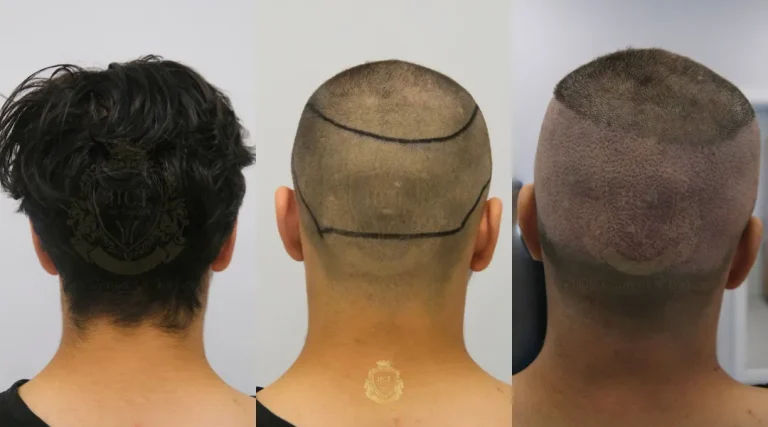
A proper assessment is a sequence, not a glance. Donor density is measured under magnification at several points across the back and sides. Trichoscopy identifies miniaturised zones that still look covered in photographs.
Recipient areas are mapped in square centimetres rather than judged by eye. Age and family history then shape the hairline, because a 28-year-old and a 48-year-old with the same recession should not get the same front line.
The output is a hair transplant graft allocation written zone by zone: so many grafts to the frontal hairline, so many to the mid-scalp, so many held in reserve. Hair Center of Turkey has run this process since 2014, with three doctors and approximately 3,000 procedures a year. For US patients it starts remotely, at no cost.
What The Free Online Hair Consultation Covers Before You Fly
The free pre-operative eligibility consultation reviews your photos and medical history. It screens for conditions that would change or rule out surgery, including uncontrolled thyroid disease, active scalp inflammation and unstable diffuse shedding.
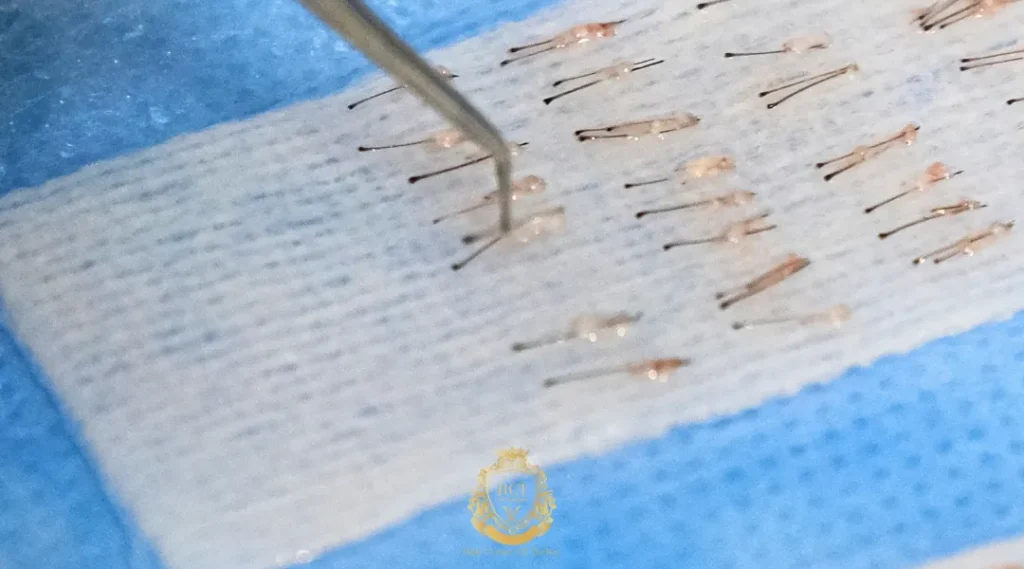
You receive a doctor-reviewed graft range with a zone plan attached. It also settles the logistics: length of stay, what happens on each day, and how follow-up runs once you are home. No deposit is required.
Surgery day can still adjust the number. Once the donor is measured in person and the recipient zones are marked, the plan is reconciled with what the donor can safely supply. The revised figure and any effect on price should be explained before extraction begins, never discovered in an invoice.
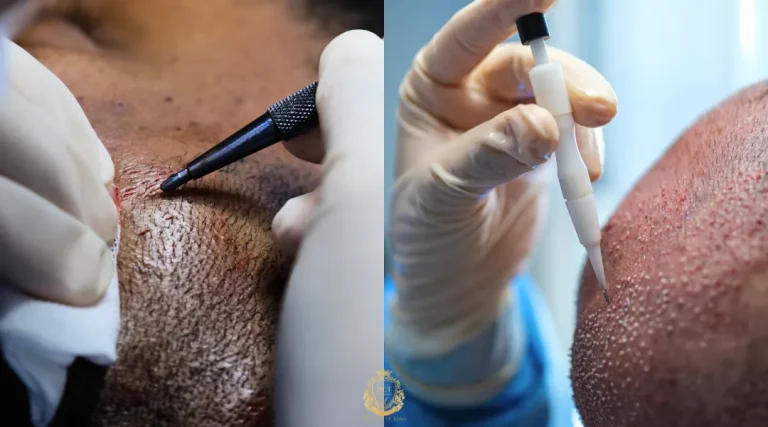
Technique changes what a number buys. Manual FUE, Sapphire FUE and DHI differ in graft handling, incision creation and packing density, so two plans quoting 3,000 grafts can deliver different coverage. Counting boards, photographed trays and a written post-operative report turn the final figure into something you can check.
How To Read A Hair Transplant Graft Quote Like A Clinician
Five items, requested in writing, separate a measured plan from a marketing number:
A zone-by-zone graft breakdown: hairline, mid-scalp, crown
The target density in grafts/cm² stated per zone
Your measured donor density, not an assumed average
The hair-per-graft assumption behind the estimate
A written policy for plan changes on surgery day
Price per graft is not the comparison tool most patients assume it is.
United States | Turkey | |
|---|---|---|
Typical pricing model | Per graft | Fixed all-inclusive package |
Cost per graft | $3-$8 | $1-$3 |
3,000-graft case | $8,000-$15,000 | ~$2,500-$5,000 |
Usually included | Surgery only | Surgery, hotel, transfers, aftercare |
One model prices a unit and the other prices an outcome. The per-graft figure alone says little about total cost or value. Before booking a hair transplant istanbul trip, check what is verifiable from a distance.
Founding year, physicians on staff and annual case volume are all straightforward to confirm. So is who performs extraction and implantation, whether published content carries medical review, and what the revision policy says in writing.
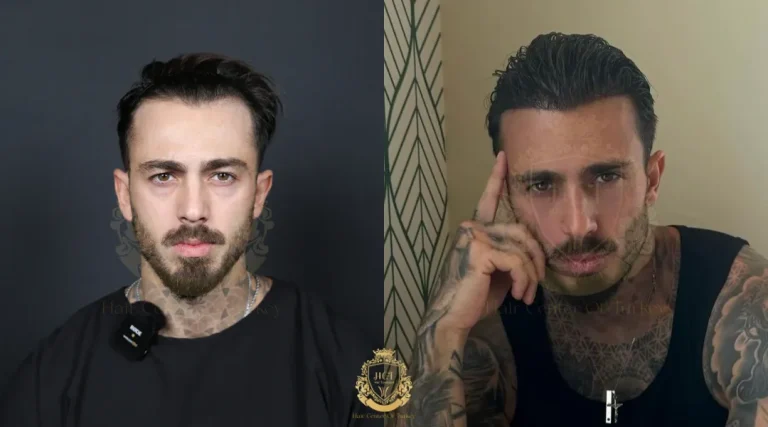
A lower number is not a worse outcome. A well-distributed 2,500-graft plan that respects hair caliber and places single units along an irregular hairline usually reads denser than a rushed 4,000-graft one. It also leaves something to work with later.
Medical Review, Sources And Related Reading
Reviewed by the Hair Center of Turkey medical team (three physicians, in practice since 2014). Review date: September 2026. This article is educational and does not replace individual diagnosis. Every figure quoted here is a population range, not a recommendation for your scalp.
Grafts-per-session data comes from the ISHRS 2025 Practice Census covering 2024 procedures. Follicular unit composition, native density and donor yield per cm² come from published hair restoration literature. Volume and staffing figures reflect Hair Center of Turkey’s own case records.
Related reading:
If you want a measured range rather than a photo guess, the free online eligibility consultation is the next step. It costs nothing, a doctor reviews it, and it gives you a hair consultation record you can hold every other quote against.
Frequently Asked Questions
Why did three clinics give me three different graft numbers for the same photos?
Each clinic applied its own assumptions: a different target density per cm², a different judgment about future loss, and sometimes a different unit entirely. Photo-based estimates are only around 40-60% accurate. The spread reflects guesswork rather than one clinic being right and the others wrong.
Is a graft the same thing as a hair?
No. A graft is a follicular unit that usually holds one to four hairs, so 2,500 grafts may transplant 5,000 hairs or more. If a hair transplant graft count sounds unusually large, check which unit it is written in before comparing it to anything else.
Can 5,000 grafts be done in one session?
It is possible but uncommon. ISHRS census data shows only about 2.2% of patients receive 4,000 or more grafts in one procedure, and most people have 4,000-6,000 usable donor grafts for life. A routine 5,000-graft promise usually signals hair-based counting or overharvesting.
Will my final graft count change on the day of surgery?
It can. Once the donor area is measured under magnification and the zones are marked, the hair transplant graft plan is adjusted to what the donor can safely supply. A reputable clinic explains the revised number and its pricing effect before extraction begins.
Do I need to fly to Turkey just to get an accurate estimate?
No. Hair Center of Turkey offers a free online pre-operative eligibility consultation. US patients get a doctor-reviewed assessment, a realistic graft range and a zone plan before committing to travel or a deposit.