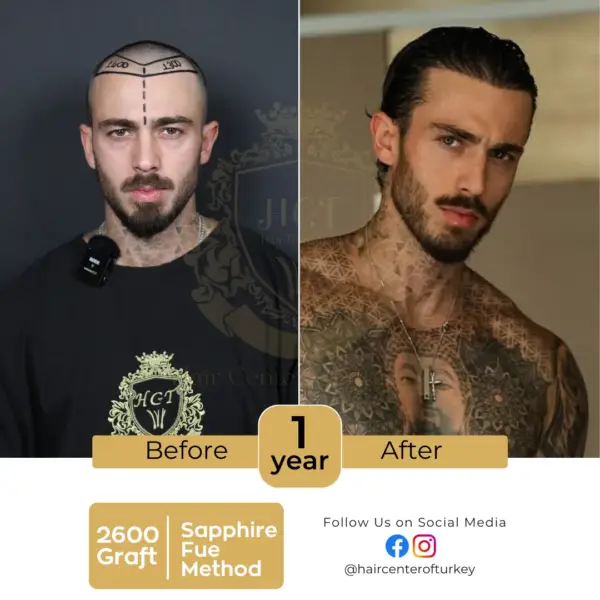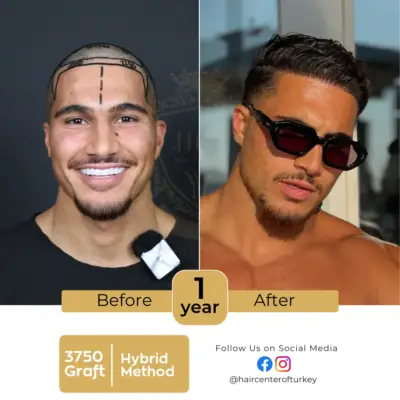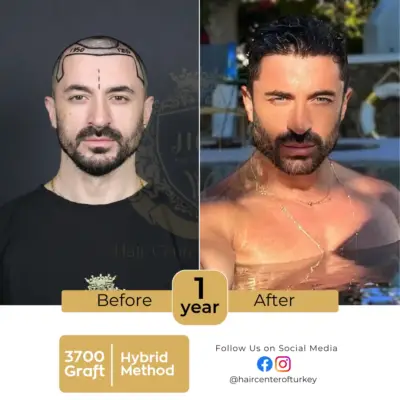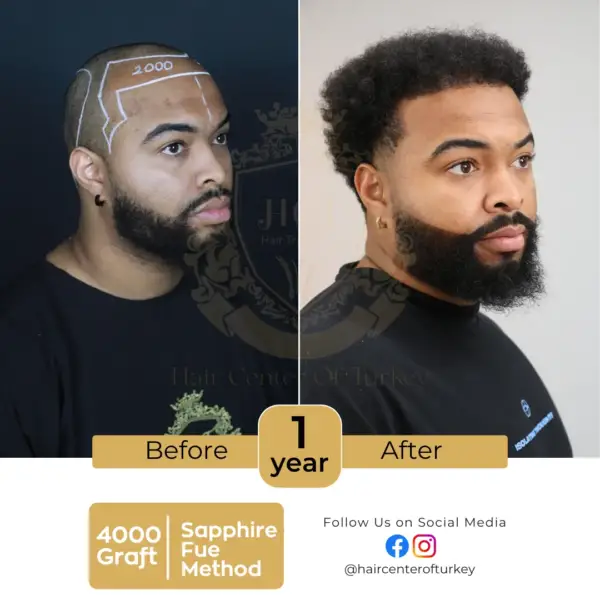


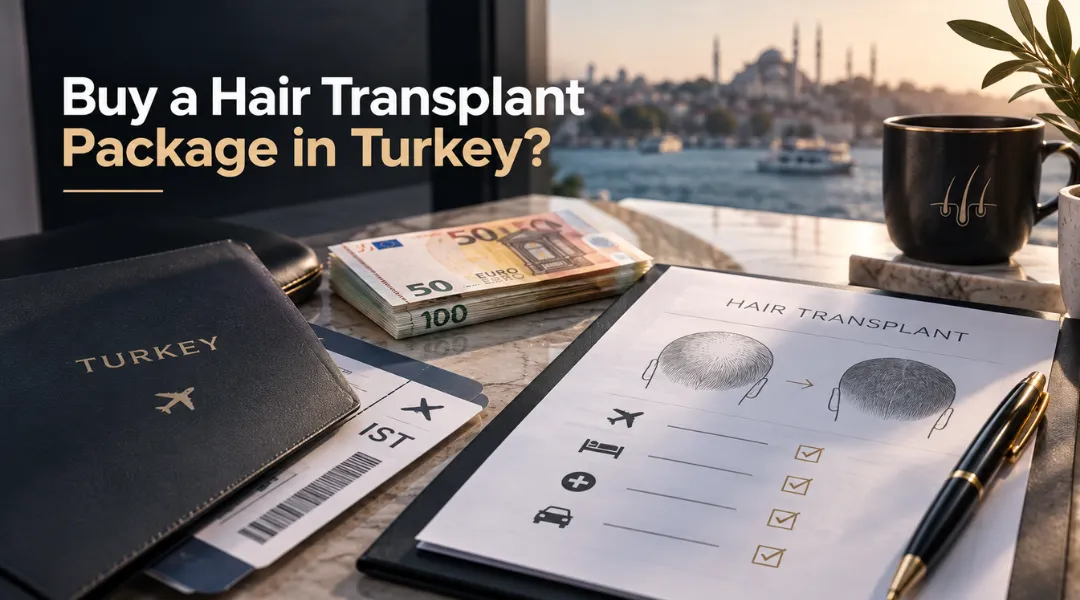
Yes. A hair transplant package in Turkey costs €2,000–€4,500 all-inclusive and covers surgery, hotel, transfers and medication — around 70% below US or UK pricing.
Does Buying A Hair Transplant Package In Turkey Actually Make Sense?
Yes, buying a hair transplant package in Turkey makes sense financially and medically, provided you choose a certified clinic. Patients can save up to 70% compared to the US or UK while receiving all-inclusive care (hotel, transfers, surgery, medications) without compromising on quality. The condition attached to that sentence carries more weight than the number itself.
Table of Contents
The price gap has structural causes, not corner-cutting ones. Istanbul hosts several hundred clinics performing hair restoration. The surgical teams working there handle case volumes that a boutique clinic in London or Chicago sees across a decade, and that repetition builds genuine technical fluency. A favourable exchange rate stretches euros and pounds against local operating costs, so a complete package lands near what a US clinic charges for the consultation and first deposit.
None of that makes Turkey automatically safe. The variable that decides your outcome is the clinic tier you book, not the country you fly to. A €1,200 offer and a €4,000 offer in the same city can differ in who opens your recipient channels, whether sedation is included, and whether anyone answers your messages six months later. The rest of this article breaks down where that difference actually sits.
Turkey vs USA And UK: Hair Transplant Prices Compared
Comparing hair transplant prices across borders only works when you compare what the price contains, not just the figure on the quote.
Metric | Turkey | United States | United Kingdom |
|---|---|---|---|
Cost Range | €2,000–€4,500 all-inclusive (€0.60–€1.20 per graft) | $8,000–$18,000, surgery only ($3–$8 per graft) | £6,000–£15,000, procedure only (£3–£6 per graft) |
What’s Included | Hotel, VIP transfers, medication, aftercare, translator | Procedure only; travel and accommodation on the patient | Procedure only; no bundled logistics |
Surgeon Involvement | Physician-led incisions, technician-assisted extraction and implantation | High surgeon chair-time per patient | High surgeon chair-time, long waiting lists |
Hidden Cost Risks | Concentrated in budget tiers and broker markups | Low, but consultation and medication billed separately | Low, though revision sessions are priced separately |
Run the numbers on a real case. A patient needing 3,500 grafts pays around €3,000 in Istanbul with hotel and transfers folded into the price. The same graft count in the United States runs $14,000 to $20,000 for the surgery alone. Flights to the clinic city, hotel nights and unpaid time off work all sit on top of that.
What The Price Difference Buys You Back Home
The saving is real, and so is what you give up for it. Treating locally means your surgeon is reachable for in-person follow-up at month three, month six and month twelve, which is exactly when small problems are still correctable. A shock-loss question or a slow-growing zone gets examined under proper lighting instead of assessed from a phone photo. It also means a malpractice claim is filed in your own legal system, in your own language, with a regulator you can actually reach.
Pursuing recourse across borders is difficult in practice. Cross-border medical claims require local counsel, translated records and jurisdiction that usually sits with the Turkish courts under the contract you signed. That is the honest trade-off inside hair transplant packages bought abroad, and it explains why verification before payment matters far more than it would at a clinic twenty minutes from your house.
What Is Included In All-Inclusive Hair Transplant Packages
A standard all-inclusive package is more specific than the marketing suggests. It covers VIP airport and clinic transfers, three to four nights in a four or five star hotel, and a pre-op blood panel. That panel screens for HIV, hepatitis B and C, coagulation function and a full blood count. The procedure runs under local anesthesia, with sedation reserved for premium tiers.
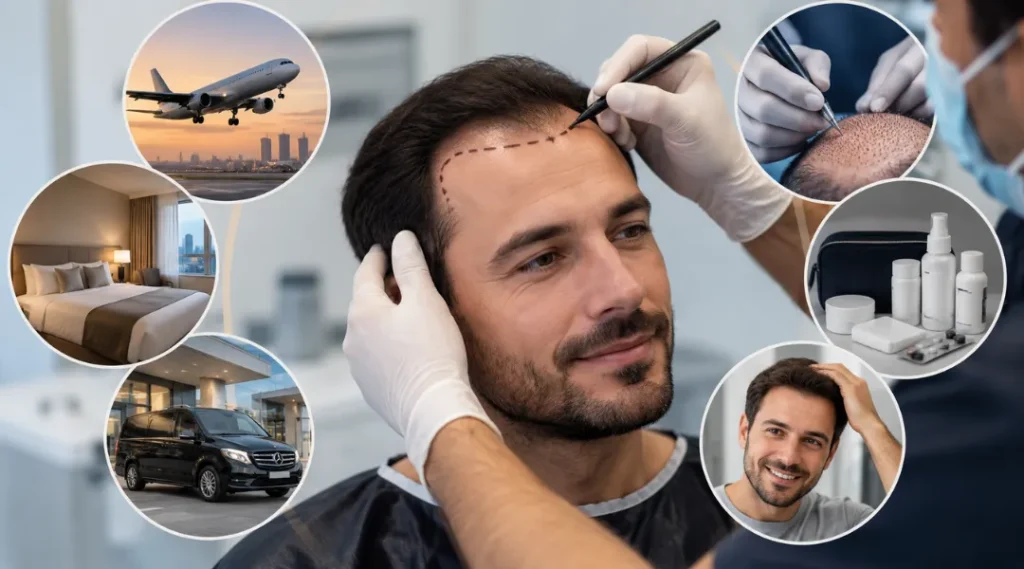
After surgery you receive a post-op care kit containing lotion, medical shampoo and prescribed medication, plus the first medical wash performed at the clinic. An English-speaking translator accompanies the consultation and the surgery day itself. Follow-up support usually runs twelve months, and premium tiers often add one PRP session to support early graft recovery.
The Standard 4-Day Package Timeline
Day 1 covers consultation, hairline design and blood tests. Day 2 is surgery, typically six to eight hours depending on graft count. Day 3 brings the first bandage removal and a donor area check. Day 4 is the first medical wash, discharge instructions and departure.
That compressed window explains why the four to five day trip structure appears in almost every package. It also means you get one realistic opportunity to raise concerns face to face. That opportunity is Day 1, before design is finalised and before anything becomes irreversible.
FUE Or DHI: Where The Extra Cost Goes
DHI packages usually price €500 to €1,200 above classic FUE. The implanter pen suits smaller sessions and dense hairline work, where control over angle, depth and direction matters most. Classic sapphire FUE handles high graft counts more economically and remains the sensible choice for larger coverage cases.
That price gap gets marketed as a quality gap. It is a technique difference. A skilled team produces excellent results with either method, and the right choice depends on your Norwood stage and donor characteristics rather than the higher invoice.
What almost no package covers deserves equal attention. Flights are excluded nearly everywhere. Extra hotel nights, if healing runs slow or a flight is missed, come out of your pocket. Year-one aftercare including finasteride, minoxidil and PRP top-ups sits outside the quoted figure entirely.
The Hidden Costs Of Cheap Hair Transplant Packages
Sub-€1,500 offers achieve their price through specific omissions. The common structure includes a rented operating slot in a shared hospital rather than a dedicated clinic, a three-star hotel, and a shared shuttle in place of VIP transfer. No sedation, no PRP session, no written graft guarantee. Aftercare exists as a WhatsApp thread that goes quiet somewhere around week three.
The price then rebuilds itself after you arrive. Sedation gets charged on the day, when you are already in the chair and unlikely to refuse. PRP is billed separately. Graft counts turn out to be capped despite “unlimited” wording in the original quote. Shaving and post-op wash appointments appear as add-ons, and any additional hotel night is yours to pay. These hidden costs of cheap transplants routinely push a €1,300 quote past €2,200.
Brokers add a second layer of markup. Agencies apply a 20% to 40% margin and route patients to whichever clinic pays the highest commission that week. The surgeon whose before-and-after gallery convinced you may have no connection at all to the operating room you end up in. Ask directly whether you are speaking to a licensed clinic or a consultancy, and ask for the clinic’s own registered name in writing.
Why ‘Unlimited Grafts’ Is A Pricing Model, Not A Promise
Your donor area sets the ceiling, not the contract. Safe extraction generally caps around 4,000 to 5,000 grafts in a single session. Many experienced surgeons prefer 3,000 to 4,000 per day, splitting larger cases across two sittings to protect donor density and reduce out-of-body time.
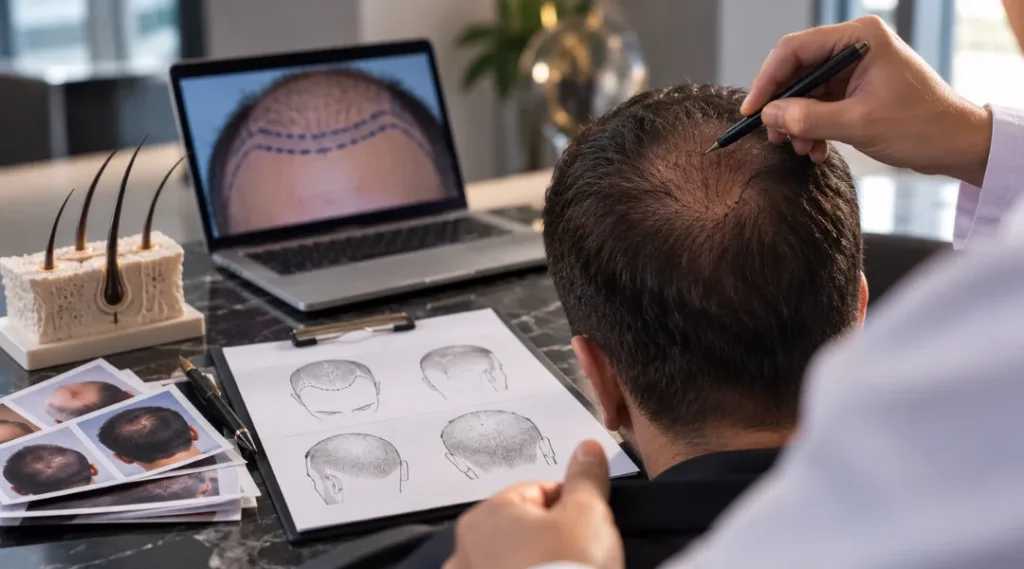
Packages advertising 6,000 or 7,000 grafts in one sitting are extracting past conservative safety limits. Over-harvesting permanently thins the donor zone, and no later procedure repairs that damage. The phrase sells volume. Biology does not negotiate.
How To Verify A Clinic Before You Pay A Deposit
Three credentials carry real weight. The Turkish Ministry of Health (T.C. Sağlık Bakanlığı) health tourism authorization certificate is the baseline legal requirement for treating international patients. JCI-accredited clinics have passed an international facility and patient-safety audit. ISHRS surgeons hold membership in the field’s main professional body. A consultancy or broker holds none of these, because it holds no medical license at all.
Ministry Of Health, JCI And ISHRS: What Each One Proves
The Ministry certificate proves the facility is legally permitted to treat you. JCI proves the facility meets international safety and hygiene standards. ISHRS membership speaks to the individual surgeon rather than the building, so a clinic can advertise an ISHRS name while assigning your case to someone else entirely. Request certificate numbers and verify them independently instead of accepting a logo on a landing page.
Who Actually Opens The Channels
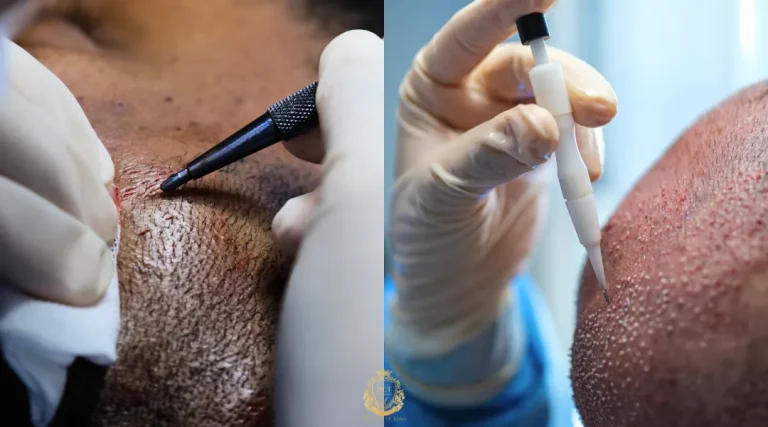
Turkish regulation requires a licensed physician to perform the recipient channel opening. Trained technicians may legally assist with extraction and implantation, and team-based work is standard practice worldwide. This single distinction is the biggest quality variable between a €1,200 and a €4,000 package.
Ask in writing which phases the doctor personally performs. Request the operating physician’s name and license number before transferring any money, and check that the name on the reply matches the name in the marketing.
Set expectations on graft survival rate accordingly. A 90% to 95% survival rate is achievable with an experienced team, shaped by extraction technique, out-of-body time and storage solution quality. Any clinic promising 100% is overselling. So is one promising a final result at three months, when growth typically reaches 30% to 40% at four to six months and final density arrives at twelve to eighteen.
Before the deposit, collect four things: an itemized written quote, before-and-after evidence from patients at a similar Norwood stage and hair type, the revision policy in writing, and clarity on whether a free touch-up covers return flights.
The Real Total Cost Beyond The Package Price
The headline figure is not your budget. Add return flights, four days on the ground, and any unpaid work days. Build in a buffer for extra hotel nights if healing runs slower than planned. A €3,000 package realistically becomes €3,600 to €4,200 by the time you land back home.
Year one adds more. Finasteride or minoxidil to protect native hair, occasional PRP top-ups, and in some cases a revision trip carrying its own airfare and accommodation. Packages rarely include any of it, and reputable clinics say so upfront rather than after the fact.
The pricing model matters to your specific case. A Norwood 4 or 5 patient needing 4,000-plus grafts genuinely wins on flat-fee pricing. A Norwood 2 or 3 patient needing 1,800 grafts subsidizes that model and would often do better with per-graft pricing. If the loss is still actively progressing, medical therapy first is frequently the sounder sequence.
Medical tourism in Turkey rewards patients who verify credentials and read the itemized quote line by line. It punishes those who shop on headline price alone. Booking a hair transplant package in Turkey is a reasonable decision when the clinic is licensed, the physician is named, and the quote holds no surprises.
Frequently Asked Questions
Are there hidden costs in a Turkish hair transplant package?
In reputable clinics, no — the quoted price covers surgery, hotel, transfers, medication and aftercare. Hidden costs appear in budget offers, where sedation, PRP sessions, extra graft counts, additional hotel nights and post-op wash appointments are billed separately. Ask for a written itemized list before paying a deposit, and confirm that flights are excluded from almost every package.
What is exactly included in an all-inclusive hair transplant package?
A standard all-inclusive package covers VIP airport and clinic transfers, three to four nights in a four or five star hotel, pre-op blood tests, the procedure with local anesthesia, a post-op care kit with lotion, shampoo and medication, the first medical wash, an English-speaking translator, and follow-up support for twelve months. Premium tiers add sedation and often one PRP session.
Is it safe to travel to Turkey for hair restoration?
Yes, when the clinic is licensed by the Turkish Ministry of Health for health tourism and the procedure takes place in an accredited facility with a physician involved in the surgical phase. The risk is not the country; it is the clinic. Verify licensing, surgeon credentials and post-op protocols rather than choosing on price alone.
How many grafts will I actually get in a hair transplant package in Turkey?
Your donor area sets the limit, not the package wording. Realistic single-session numbers run 2,000 to 4,500 depending on donor density and Norwood stage. Treat unlimited grafts as a pricing model, since safe extraction has a biological ceiling and over-harvesting permanently thins the donor zone.
When will I see the final result, and what happens if it fails?
Shedding starts around week two to four, new growth appears at three to four months, and final density lands at twelve to eighteen months. Reputable clinics provide a written graft guarantee promising a free revision if survival falls below an agreed threshold. Check whether that revision includes flights and accommodation, because most do not.